
Verified operating data · anonymised case study
41.44kWh FoxESS retrofit: high utilisation starts with the right energy path.
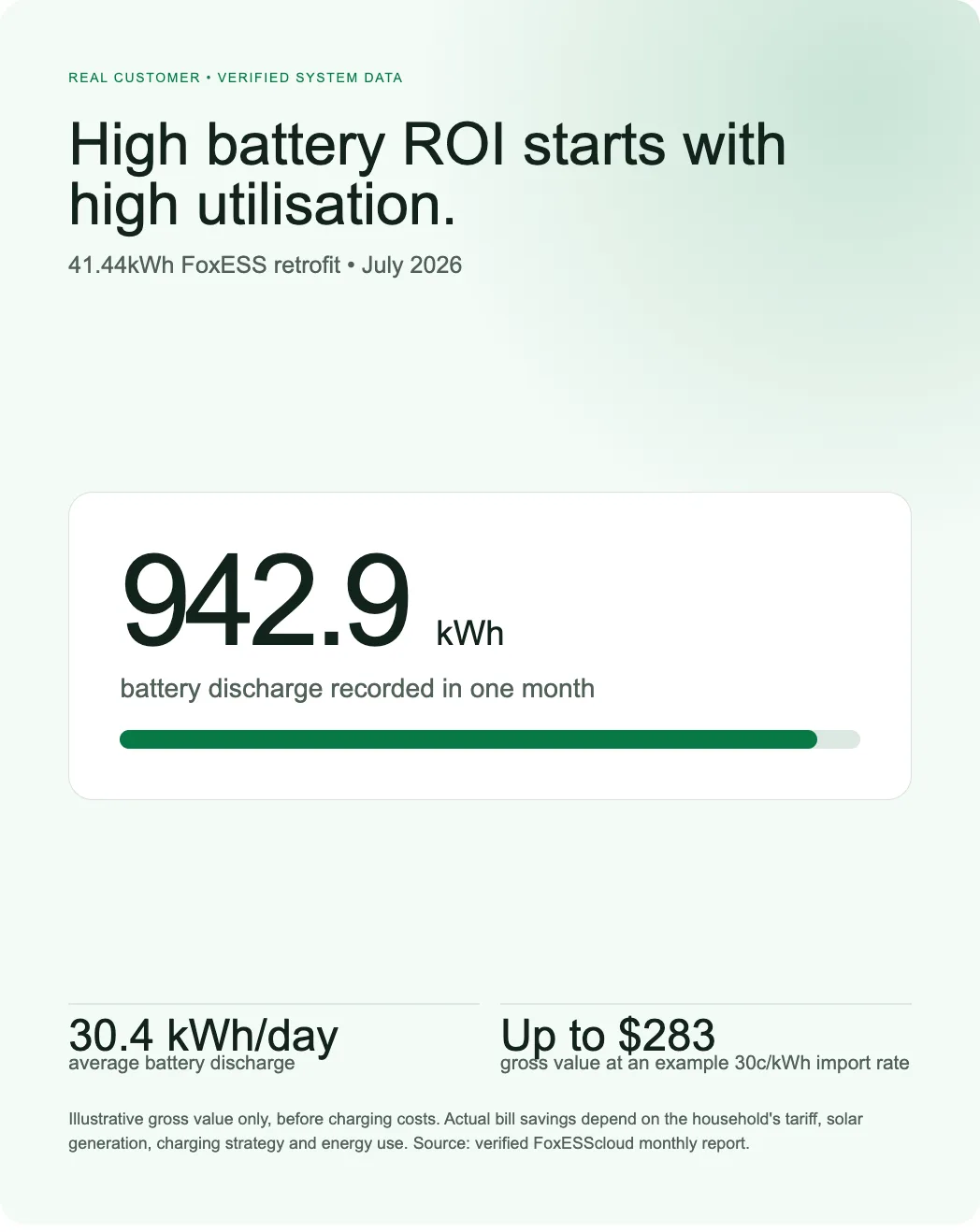
One real SUNNY Energy customer with existing solar upgraded to 41.44kWh of FoxESS storage. The month’s monitoring data is useful because the limits are shown alongside the headline number.
Real-project quote breakdown
Five separate decisions behind the headline capacity.
This is a scope breakdown of the verified project—not a copy of the customer’s private proposal and not a current fixed-price offer. It shows what must be separated before two quotes can be compared honestly.
1 · Storage
Four EP11 modules provided 41.44kWh total storage. The module count and usable capacity should be written explicitly rather than described only as a “large battery”.
2 · Inverter path
The verified inverter was a FoxESS KH9.9. Capacity in kWh and inverter power in kW answer different questions and should appear as separate quote lines.
3 · Existing-solar interface
This was a retrofit to an existing solar system. A comparable proposal must state what existing equipment remains and how the new battery system interfaces with it.
4 · Monitoring and handover
FoxESScloud supplied the operating evidence used here. Account setup, commissioning and monitoring handover should be clear deliverables, not assumed extras.
5 · Site-dependent scope
Backup circuits, switchboard rectification, cable routes and other site work are not proven by the monitoring data and are not claimed as included here. A firm proposal must confirm them separately.
What was verified
A real result, not a generic ROI calculator.
The system chain was verified across the project records and FoxESScloud: a FoxESS KH9.9 with four EP11 battery modules, totalling 41.44kWh, added to an existing solar system. FoxESScloud recorded 942.9kWh of battery discharge over 31 active days in July 2026.
That works out to approximately 30.4kWh per day (942.9 ÷ 31). Applying an example import rate of 30c/kWh gives 942.9 × $0.30 = $282.87, rounded in the public data card to up to $283 gross value.
The figure is deliberately labelled as gross and illustrative. It does not subtract charging energy, retailer tariff structure, fixed charges, export income or the customer’s actual bill.
What the case demonstrates
- Monitoring can show whether storage is being used regularly.
- Capacity should be considered alongside household load and solar generation.
- A retrofit can be evaluated with real operating evidence after commissioning.
What it does not demonstrate
- It does not guarantee the same discharge on another property.
- It is not a before-and-after electricity-bill comparison.
- It does not replace an equipment, tariff or site assessment.
Want your own utilisation estimate?
Send a recent electricity bill and your existing inverter model. We’ll separate a preliminary estimate from the evidence still needed for a written proposal.
Case-study questions
Read the number in context.
Is the 942.9kWh figure the customer’s bill saving?
No. It is battery discharge recorded by FoxESScloud during July 2026. The illustrative $283 figure applies an example 30c/kWh import rate before charging costs; it is not a bill comparison or a guaranteed saving.
What system produced the result?
The verified system chain was a FoxESS KH9.9 with four EP11 battery modules, 41.44kWh total storage, connected as a retrofit to existing solar.
Will another 41.44kWh system deliver the same result?
Not necessarily. Discharge depends on solar generation, household use, tariff, charging strategy, system settings and the way the home operates. This is a real data point, not a performance promise.
Related guides
Choose capacity from evidence, not hype.
Installer comparison
How to choose a solar battery installer in Brisbane
Compare accreditation, equipment, site scope, backup, warranties and after-sales responsibility before signing.
Read the guide →Three-phase design
Three-phase home battery guide for Brisbane
Understand inverter architecture, existing solar, metering, Energex connection pathways and blackout scope.
Read the guide →Warranty and support
Home battery warranty and after-sales support
Separate product, performance and workmanship cover, registration, consumer rights and the fault pathway.
Read the guide →